Madikok Neurosurgery Clinic Doctor's Column
Neurosurgery & Orthopedics Column

Herniated Disc in Your 20s: What Causes It?

Explains the causes and symptoms of a herniated lumbar disc, which also occurs in people in their 20s, along with how a nerve block works and what to keep in mind.

Published 2026-11-02 Updated 2026-11-02 Reviewed by Gyochang Song, Medical Director · Neurosurgery Specialist

A herniated lumbar disc is not a condition that suddenly appears at a particular age; it is the result of poor posture and lifestyle habits building up over a long time. In fact, about 20% of all patients are in their 20s and 30s, a figure also confirmed in 2018 statistics from the Korean Neurosurgical Society. This article covers the causes and symptoms of herniated discs in younger people, and the nerve block procedure.

01

Is a herniated disc caused only by ageing?

Key point
In many cases, a herniated disc stems from poor posture and lifestyle habits rather than from ageing, so it is not rare among people in their 20s and 30s. In fact, about 20% of all patients fall into this younger age group.

Between the vertebrae sits the intervertebral disc, a soft structure that absorbs shock, made of a tough outer layer called the annulus fibrosus and a soft inner core called the nucleus pulposus. When poor posture, a habit of repeatedly lifting heavy objects and a lack of exercise combine, the nucleus can be pushed out beyond the annulus and press on a nerve, causing pain and nerve symptoms. This is called lumbar disc herniation, commonly known as a herniated disc.

According to 2018 statistics from the Korean Neurosurgical Society, patients in their 20s and 30s account for about 20% of the total. Sitting for long periods raises the pressure on the lower back considerably compared with standing, a hunched posture that becomes fixed builds up strain on the spinal muscles, and a weak core or weight gain also increases the load on the disc.

  • Sitting for long periods — pressure on the lower back is higher than when standing, increasing the strain on the disc
  • Hunched posture — once poor posture becomes fixed, strain builds up on the muscles around the spine and on the disc
  • Lack of exercise and a weak core — when weight gain and reduced muscle strength combine, the load on the disc increases
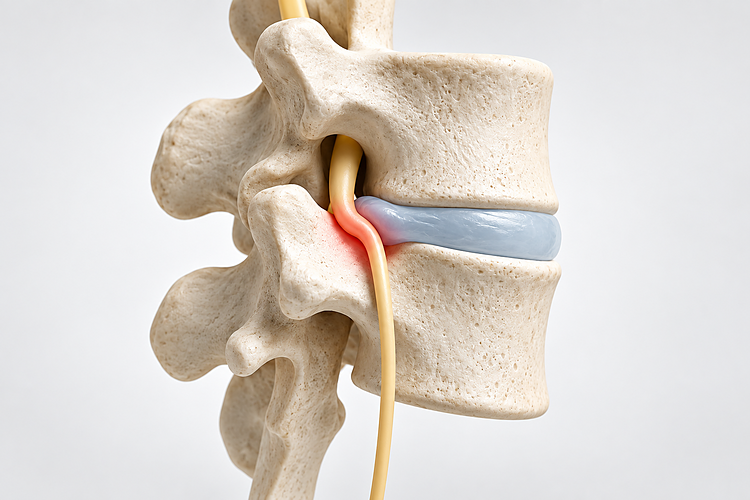
Anatomy illustration related to Herniated Disc in Your 20s: What Causes It?
02

What symptoms does a herniated disc cause?

Key point
In the early stage it begins as mild lower back pain, but the more strongly the disc presses on a nerve, the further radiating pain spreads to the buttocks and legs, accompanied by numbness. When it becomes severe, the legs may also lose strength.

In the bulging stage, when the nucleus swells within the annulus, it is easy to dismiss as a dull ache when sitting for a long time, but in the protrusion stage, when part of the annulus tears and irritates a nerve, radiating pain and abnormal sensations become clear. In the extrusion stage, when the annulus ruptures completely and the nucleus leaks out, severe radiating pain and difficulty walking can appear, and in rare cases it can lead to bladder or bowel problems or paralysis, so the pain should not be taken lightly.

  • Bulging stage — the nucleus swells within the annulus, causing a dull ache when sitting for a long time and stiffness in the morning
  • Protrusion stage — part of the annulus tears and irritates a nerve, causing radiating pain and abnormal sensations, with pain worsening on coughing
  • Extrusion stage — the annulus ruptures and the nucleus leaks out, causing severe radiating pain and difficulty walking, and rarely even paralysis
03

What is a nerve block, and can it be given at any time?

Key point
A nerve block is a non-surgical treatment that delivers medication around a compressed nerve to settle inflammation and swelling. Rather than being given simply because there is pain, it should be performed at an appropriate time after a precise diagnosis if an effect is to be expected.

A nerve block is a representative non-surgical treatment in which medication is carefully injected around the area where a nerve is compressed, reducing inflammation and swelling to ease pain, on a principle similar to spraying a fire extinguisher where a fire has started. A combination of long-used medications such as lidocaine, steroids and antibiotics is injected after local anaesthesia, so even older patients or those with systemic conditions can undergo the procedure in a relatively stable manner.

However, having an injection straight away just because there is pain can be a problem, because the approach differs depending on the cause, the location of the lesion and the shape of the nerve, and performing it without a precise diagnosis makes it difficult to achieve an effect. The key is for the injection to spread sufficiently near the nerve and to the epidural lesion, and its effect drops if it is placed around the bone, so appropriate timing and a precise diagnosis need to go together.

Gyochang Song, Medical Director
Doctor's view

How the doctor decides

Gyochang Song, Medical Director · Neurosurgery Specialist

I do not recommend the procedure straight away just because there is pain

I do not recommend a nerve block immediately just because a patient complains of pain. I first confirm the location of the lesion and the way the nerve is compressed through a precise diagnosis, and I proceed only after deciding the timing and method that fit that result.

I pay the most attention to whether the medication spreads near the nerve

Because I believe that an injection that stays around the bone is unlikely to give the expected effect, I treat an approach that spreads the medication precisely near the nerve and to the epidural lesion as the core of the treatment.

I do not take the cause lightly just because the patient is young

I judge that even in a patient in their 20s, a disc problem can progress if habits of sitting for long hours, posture and a lack of exercise build up, so I try to review lifestyle habits as well, regardless of age.

After treatment, I also give guidance on correcting posture and lifestyle habits

Because I believe that however good a treatment is, the problem can return if everyday posture and lifestyle habits stay the same, I try to guide patients on correct posture and improving lifestyle habits after the procedure as well.

Summary

In summary

A herniated disc can appear as lifestyle habits build up, so it is important not to dismiss pain just because you are young. If you feel numbness and radiating pain, or if the pain worsens even with movements such as coughing, it is advisable to have a precise diagnosis. A nerve block can be expected to work when it is supported by an accurate diagnosis and a precise approach, so it is important to confirm the cause first and to keep up correct lifestyle habits alongside the treatment.

FAQ

Frequently asked questions

QIsn't a herniated disc something young people rarely get?
A

That is not the case. According to 2018 statistics from the Korean Neurosurgical Society, people in their 20s and 30s make up about 20% of all herniated disc patients. When lifestyle habits build up, a disc problem can progress regardless of age.

QHow can I tell if I have a herniated disc?
A

It can be suspected if lower back pain comes with numbness or radiating pain towards the buttocks or the back of the legs, or if the pain worsens even with small movements such as coughing. As symptoms progress, leg weakness or, rarely, bladder or bowel problems can appear, so it is advisable to see a doctor.

QIs a nerve block a type of surgery?
A

No. A nerve block is not surgery but a non-surgical treatment that injects medication around a compressed nerve to settle inflammation and swelling. It is performed by injection after local anaesthesia, so even older patients or those with systemic conditions can receive it in a stable manner.

QIf I have pain, can I have a nerve block right away?
A

Having an injection straight away is not recommended. The approach differs depending on the cause and the location of the lesion, so it is important to have a precise diagnosis first and then decide the appropriate timing and method.

Gyochang Song, Medical Director
Medical review
Gyochang Song, Medical Director · Neurosurgery Specialist
This content is general medical information and may not apply to every individual. Diagnosis and treatment are decided through a consultation.