Extracorporeal shockwave therapy is a non-surgical treatment that repeatedly delivers shockwaves to damaged tendons, muscles or ligaments to stimulate tissue regeneration, and it is often used for long-standing pain such as calcific tendinitis of the shoulder, tennis elbow and plantar fasciitis. If pain does not ease after several sessions, the treatment method needs to be checked before more sessions are added.
The effect depends far more on how the energy was delivered and to which point than on how many sessions were given, and whether other treatments are combined also has to be considered before it leads to a real reduction in pain. This article covers how the treatment reduces pain, the key factors that decide its effect, the appropriate number of sessions and interval, and the treatments that should go alongside it.
How does shockwave therapy reduce pain?
When pain lasts a long time, the body comes to accept that state as normal and stops its own attempts to heal. Shockwave therapy works by applying a strong impact from outside to reawaken this stalled healing response. Worn-out cells are stimulated and regain the capacity to regenerate, blood flow increases and new blood vessels form, so regenerative cells gather quickly at the damaged area.
As regenerative cells gather, inflammation gradually settles and tendon or ligament tissue regenerates firmer than before. This is less about reducing pain in the moment and closer to a process of creating conditions in which the tissue is not damaged again. Shockwave therapy is better understood not as a painkilling treatment that briefly covers pain, but as a regenerative treatment that helps the tissue recover by itself.
If not the number of sessions, what decides the effect?
The focused type concentrates energy on one point and reaches deep tissue, making it suitable for deep damage to tendons or ligaments, while the radial type spreads energy widely and suits shallow muscle or fascia. Depending on where the damage lies, the choice between the two types has a large influence on the result.
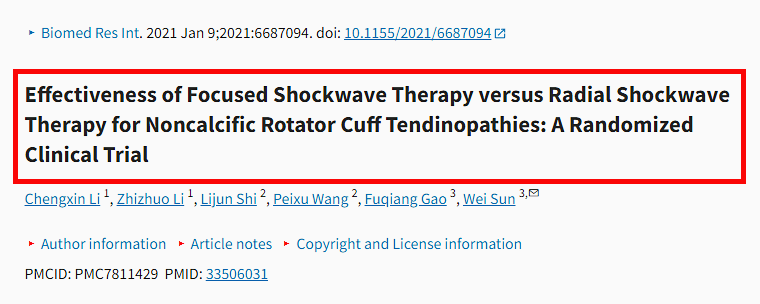
A clinical review comparing focused and radial shockwaves in patients with rotator cuff tendinopathy divided 46 patients into two groups of 23 and treated each with 4 sessions. Early on the difference between the groups was small, but after follow-up of 24 weeks or more the focused group showed a significantly better effect. This shows that the energy has to reach the damaged area precisely for the treatment to work, and that the choice of mode alone can change the result considerably.
- Focused mode — concentrates energy on one point, suitable for deep damage to tendons or ligaments
- Radial mode — spreads energy widely, suitable for pain in shallow, surface-level muscle or fascia
- Energy intensity — has to be lowered or raised according to the degree of damage and inflammation to prevent tissue injury
How many sessions of shockwave therapy are needed, and how far apart?
When damage is mild and recovery is quick, around 3 sessions can noticeably reduce pain, but when inflammation is widespread or damage is deep and recovery slow, 5 or more sessions may be needed, so a fixed number is hard to use as a standard. Age, existing conditions and lifestyle also affect the speed of recovery, so even with the same diagnosis the number of sessions needed is decided differently for each patient.
Treating only the painful spot in isolation is not enough either. With elbow pain, for example, the biceps or shoulder muscles are often involved as well, and forearm muscle tension or wrist alignment problems are commonly tangled in. Planning has to look not only at where the pain started but also at the connected tissue around it to reach a well-rounded result.
- Degree of damage — the greater the inflammation and tissue damage, the more sessions are needed
- Recovery response — the speed at which cells regenerate differs with age and existing conditions
- Lifestyle — everyday posture and activity level affect the speed of recovery and whether pain returns
Is shockwave therapy alone enough to finish treatment?
Its ability to settle severe inflammation quickly is limited, so during a period of intense pain it is often necessary to calm the inflammation first with injection treatment. Repeating the stimulation while inflammation remains active can slow recovery, so inflammation control and regenerative stimulation have to be planned together.
If the cause is structurally misaligned joints or faulty movement patterns, shockwave therapy alone has difficulty correcting it, and manual therapy or exercise therapy has to proceed alongside to restore alignment and correct movement habits so that the pain does not keep returning. Because the cause of damage and the recovery response differ for each patient, redesigning the plan stage by stage is the more favourable approach for preventing recurrence.
- Injection treatment — settles severe inflammation first, raising the effect of regenerative treatment
- Manual therapy — corrects misaligned joints and muscles, reducing recurrence
- Exercise therapy — corrects faulty movement patterns, helping prevent pain from returning