Madikok Neurosurgery Clinic Doctor's Column
Neurosurgery & Orthopedics Column

Why Does Knee Osteoarthritis Develop Even in Your 30s and 40s?

Why knee osteoarthritis can develop at a young age, what happens when it is left untreated, and how non-surgical treatment and long-term care are used to manage it.

Published 2026-10-21 Updated 2026-10-21 Reviewed by Gyochang Song, Medical Director · Neurosurgery Specialist

Knee arthritis is easily thought of as a condition of older people, but it is influenced by lifestyle as well as ageing and also appears in people in their 30s and 40s. This article covers why degenerative change develops at a young age, the problems that follow when it is left alone, and how it is treated. To state the conclusion first, knee cartilage does not regenerate, so it is advisable to have the knee checked in the early stage while symptoms are mild and to respond with non-surgical treatment and steady care.

01

Why does osteoarthritis develop even at a young age?

Key point
Osteoarthritis of the knee is a condition in which cartilage, the cushion between the knee bones, wears away so that bone rubs against bone and inflammation develops. Cartilage wears naturally with age, but when poor posture, obesity, repetitive activity and past knee injury combine, degenerative change can appear at a young age as well.

Knee cartilage covers the surfaces inside the joint, protects the bones from striking each other and absorbs outside impact so that the knee moves smoothly. The more it is used, however, the more it inevitably wears. When ageing is added, degenerative change begins, and once the cartilage has worn away the bones rub against each other and inflammation develops.

People who are used to sitting on the floor often hold the knees bent in a cross-legged position for long periods, which easily raises the pressure on the cartilage. Those who are overweight, those who use the knee heavily through excessive sport, and those whose knee function has been weakened by a past injury such as a cruciate ligament tear or chondromalacia can also experience arthritis in their 30s and 40s.

  • Poor posture — sitting for a long time with the knees bent, as in a cross-legged position, increases pressure on the knee cartilage
  • Obesity — excess weight increases the pressure placed on the knee cartilage
  • Repetitive activity — excessive sport or strenuous activity increases use of the knee and leads to cartilage wear
  • Past knee injury — a knee weakened by a cruciate ligament tear or chondromalacia can go on to develop arthritis
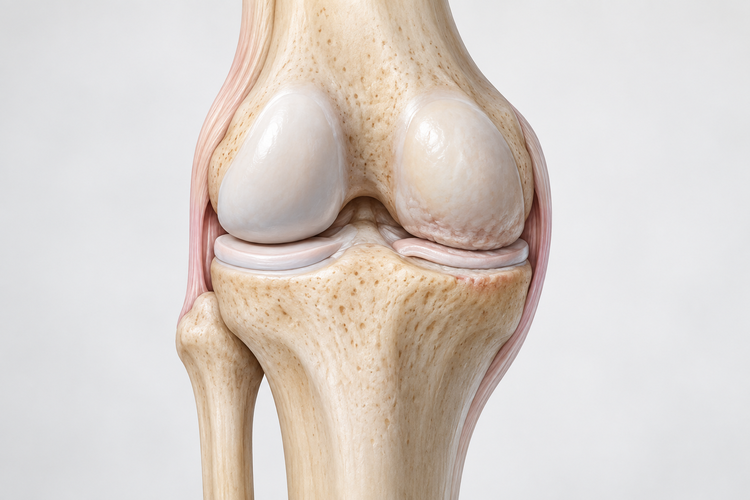
Anatomy illustration related to Why Does Knee Osteoarthritis Develop Even in Your 30s and 40s?
02

What problems arise if knee arthritis is left untreated?

Key point
In the early stage there is only a dull ache, so it is easy to leave alone, but as friction and inflammation in the joint worsen, swelling and warmth appear and the knee hurts even at rest. Because cartilage does not regenerate, neglect can lead to joint deformity, difficulty walking and consideration of surgery.

In the early stage, when wear of the knee cartilage has just begun, pain is not severe and only a dull, aching discomfort is felt, so most people leave it alone. As friction inside the joint increases and inflammation worsens, swelling and warmth appear together, and the condition moves on to a stage in which the knee throbs even when the person is sitting and not walking.

Knee cartilage is a structure that does not regenerate once it has worn away. When arthritis progresses and the shape of the joint becomes deformed, the way a person walks changes and walking itself can become difficult. In many cases surgery eventually becomes unavoidable, which is why responding with early treatment while pain is still mild is the more advisable course.

  • Change in gait — as the shape of the joint becomes deformed, a way of walking different from usual appears
  • Difficulty walking — as deformity progresses, walking itself becomes hard and daily life is affected
  • Consideration of surgery — cartilage does not regenerate, so surgery comes to be considered as the condition progresses
03

Does knee arthritis need joint replacement surgery from the start?

Key point
Surgery is not needed from the start. Non-surgical treatment such as medication, physiotherapy, injection and manual therapy is used to suppress inflammation and promote tissue regeneration, and clinical results also tend to show good outcomes for pain relief and recovery of function with these methods.

Many people worry about joint replacement surgery first, but treatment of knee arthritis begins with conservative, non-surgical methods. Several approaches are used to stimulate cell growth, suppress inflammation and promote tissue regeneration, and in actual clinical results these non-surgical methods tend to show good outcomes for pain relief and recovery of function.

The key to managing knee arthritis is early treatment before cartilage damage becomes more severe. Even after treatment, however, adjusting lifestyle habits and establishing an exercise routine for long-term care is essential so that the condition does not return. Keeping in mind that steady care is stronger than treatment helps the knee stay sturdy 10 or 20 years from now.

  • Non — surgical treatment methods — medication, physiotherapy, injection treatment and manual therapy are used according to the situation
  • Treatment goals — pain and function are improved by stimulating cell growth, suppressing inflammation and promoting tissue regeneration
  • Long — term care after treatment — lifestyle adjustment and an exercise routine help prevent knee arthritis from returning
Gyochang Song, Medical Director
Doctor's view

How the doctor decides

Gyochang Song, Medical Director · Neurosurgery Specialist

I do not simply say 'it is your age'

Patients in their 30s and 40s are often taken aback when they hear a finding of arthritis and ask why it has developed at their age. I do not explain it by age alone. I first ask about sitting habits such as sitting cross-legged, body weight, sport and activity level, and any history of knee injury such as a cruciate ligament tear or chondromalacia. I do this because the cause that brought the degenerative change forward has to be known before the direction of care after treatment can be set.

I do not pass over the words 'it was bearable'

In the consulting room I very often hear patients say 'it used to be bearable'. Early cartilage wear causes only a dull ache and is easily left alone, but cartilage is a structure that does not regenerate. So I first check whether there is swelling and warmth, and whether the knee hurts even when it is not moving, to see how far the condition has progressed.

I do not recommend surgery from the start

Many patients worry about joint replacement surgery first, but I respond first with non-surgical treatment such as medication, physiotherapy, injection and manual therapy. Even after treatment has finished, I guide patients to continue long-term care through lifestyle adjustment and an exercise routine, because I consider steady care to be stronger than treatment.

Summary

In summary

Knee osteoarthritis can appear even in the 30s and 40s, depending on lifestyle habits. Because cartilage does not regenerate, it is important to have the knee checked in the early stage, while the ache is still mild, and to respond with non-surgical treatment and steady care. If your knee swells on days when you have walked a lot, or throbs even while you are sitting, it is advisable to have the condition of the knee joint examined.

FAQ

Frequently asked questions

QIs all knee pain arthritis?
A

Knee pain does not always mean arthritis, but arthritis is a real possibility. If the pain keeps returning, or there is swelling or warmth, it is a good idea to have the condition of the knee joint checked.

QDoes worn knee cartilage grow back?
A

Knee cartilage is a structure that does not regenerate. It needs to be addressed with early treatment before the damage becomes more severe, and then managed through lifestyle habits and exercise.

QOnce treatment is finished, is further care unnecessary?
A

Even after non-surgical treatment, long-term care with lifestyle adjustment and an exercise routine is essential to prevent the condition from returning. Steady care helps the knee hold up 10 and 20 years later.

Gyochang Song, Medical Director
Medical review
Gyochang Song, Medical Director · Neurosurgery Specialist
This content is general medical information and may not apply to every individual. Diagnosis and treatment are decided through a consultation.