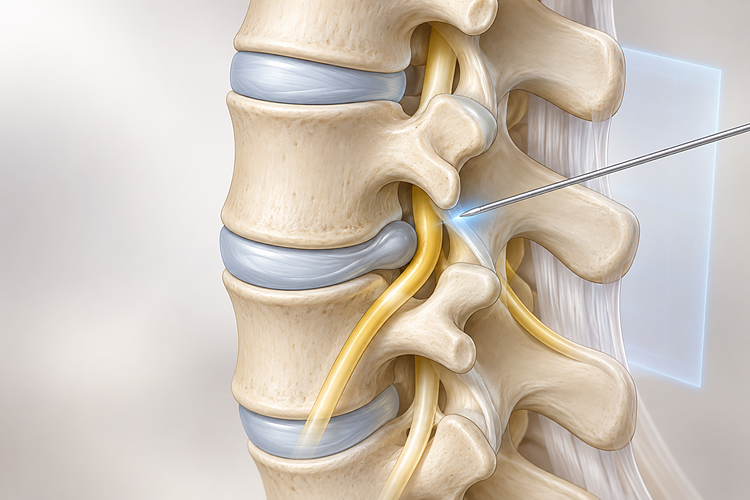
When pain from a herniated lumbar disc or spinal stenosis is severe, a nerve block is the non-surgical treatment that is commonly recommended. It is easy to mistake it for a procedure in which a needle is inserted into the bone, but in fact it is a treatment that injects medication around the inflamed nerve to help the nerve recover.
A nerve block is a treatment whose safety has been confirmed, but it is not something to be given at just any time or to just anyone. Whether it is given and how many times depend on the medical history and the degree of pain, and some people improve after 1 session while others need 3 or more sessions.
Is a spinal injection given directly into the bone?
In most cases, low back pain begins when a protruding disc irritates the surrounding tissue and produces inflammatory substances, and the nerve irritated by that inflammation sends pain signals. A nerve block works by precisely injecting medication into the narrow space around this nerve to reduce the inflammation and swelling.
Once the medication reaches the area around the nerve, the swollen tissue settles, and the compressed nerve is relieved of pressure and gains room to recover. There may be a brief sting as the needle passes through the skin and a heavy sensation at the moment of injection, but in most cases it is at a tolerable level.
Does everyone with a herniated disc or spinal stenosis need a nerve block?
Imaging results and the actual degree of pain do not always match. Some people have severe pain although the imaging shows nothing abnormal, and others have clear findings yet feel almost no pain. For this reason the need for the procedure is not decided on imaging alone, and clinical symptoms have to be considered as well. It is also not uncommon for a disc that looks serious to improve.
A nerve block cannot be given indiscriminately simply because a patient feels burdened by the idea of an incision, surgery or general anaesthesia. Whether to proceed can be decided only after the medical history and any systemic conditions have been fully understood, and the following are typical cases in which the procedure is restricted or needs careful review.
- Medical history not confirmed — if the history and systemic conditions are not understood, the response is hard to predict, so the procedure is restricted
- A severe state in which surgery is unavoidable — if the condition is already at a level that needs surgery, recovery through injection alone is difficult
- Serious systemic disease — when the general condition is poor, the response to the medication and the recovery are hard to predict
- Relying on injection treatment alone — depending only on injections without an underlying plan upsets the balance of care
How many nerve block sessions does it take to see an effect?
The speed at which the effect of a nerve block appears varies widely between individuals. Some patients find their pain reduced after just 1 session, while others notice improvement only after going through 3 or more, and this depends on the state of the disc, the degree of inflammation and individual differences in how pain is felt.
Repeating the procedure excessively at intervals that are too short can instead place a burden on the body and do harm. How many sessions to have and at what interval is better decided after discussing it with the treating medical team while watching the progress, and if there is no improvement, a surgical approach also has to be considered.
What should be checked to raise the effect and reduce side effects?
A procedure given excessively in a situation where it is not needed can lead to side effects, and if there is an error in where the medication is injected, the pain-relieving effect can fall considerably. Because the essence of the pain is the inflammation and swelling surrounding the nerve, the precision with which the medication reaches that point decides whether the procedure succeeds.
To raise the effect and lower side effects, the schedule needs to be discussed with a medical team that explains the state of the disc and the treatment plan thoroughly. An approach in which a treatment plan for the body's recovery is drawn up together is important, and a nerve block can be the key to that recovery.
- Is this a point at which the procedure is really needed — excessive procedures can bring side effects, so this is checked first
- Was the medication delivered to the exact location — the effect falls even if it is only slightly off the inflamed area
- Was the treatment plan explained thoroughly — knowing the current state and the plan reduces anxiety